Historic Preservation Commission

The City of Florence established a Historic Preservation Commission in 2015 and it has seven citizens, one non-voting City Council member, and one non-voting youth member. The City is a Certified Local Government (CLG) from the National Park Services and hopes to access no-match grants to conduct preservation studies in Florence.
The Commission is tasked with establishing a local historic register that can help protect historic buildings.
If you have further questions or would like to serve on the commission, please contact the Planning Director.
Planning Director - Ashley Fox
- (719) 784-4848 option 7
- ashley.fox@florencecolorado.org
FHPC meetings are held on the last Tuesday of the month at 4:30 pm in City Council Chambers.
Brandon Angel
Position: Chair
Term: Expires December 31, 2026
Millie Wintz
Position: Vice Chair
Term: Expires December 31, 2026
Fran Black
Position: Commissioner
Term: Expires December 31, 2026
Scott McMillin
Position: Commissioner
Term: Expires December 31, 2026
Sue Kinzer
Position: Commissioner
Term: Expires December 31, 2026
Sherry Skye Stuart
Position: Commissioner
Term: Expires December 31, 2028
VACANT
Position: Commissioner
Term: Expires December 31, 2026
LOCAL HISTORIC REGISTRY LIST:
Florence Elks Lodge - 131 East Front Street
Senior Center - 100 Railroad Street
The Knights of Pythias/Castle Hall - 105 West Main Street
Woods Building - 318 West Main Street
The First Baptist Church - 201 East 2nd Street
Lobach Block - 125 East Main Street
Morgan Building - 109 West Main Street
St. Albans Episcopal Church - 307 East 2nd Street
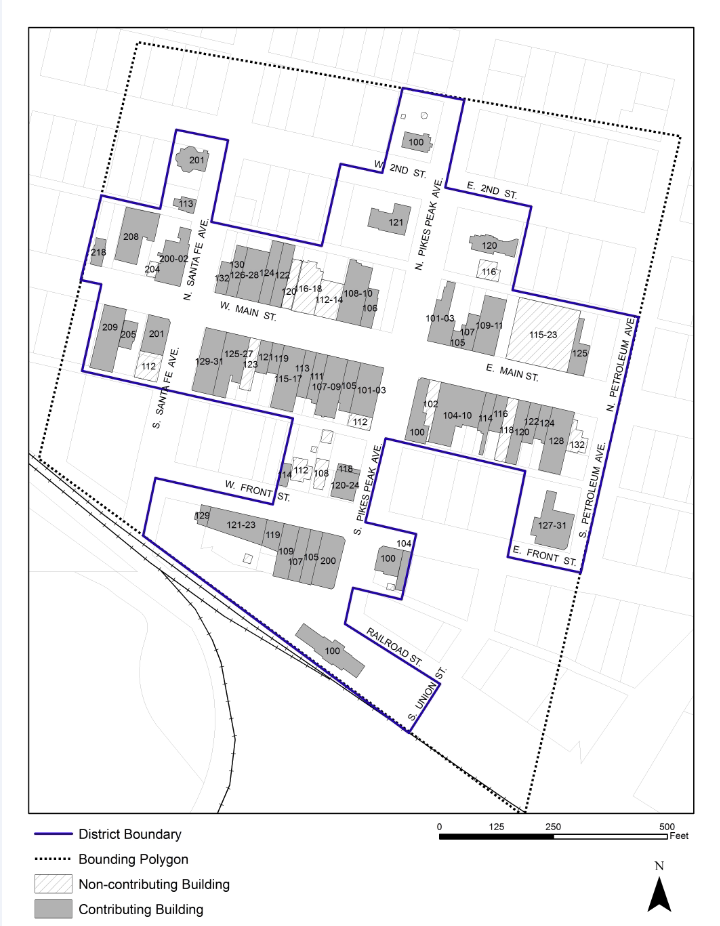
Downtown Florence Historic District
The application was approved by the State Review Board Meeting on May 19th, 2017 in Denver. As of July 14th, 2017, Downtown Florence Historic District is officially listed on the National Register of Historic Places.


The Historic Florence High School, located at 215 North Maple Avenue, has officially been listed on the National Register of Historic Places. The City of Florence, the City of Florence’s Historic Preservation Commission and the property owners sponsored the nomination for the National Register through funding provided by a History Colorado State Historical Fund grant. A consultant prepared the nomination materials, provided in part from the Pioneer Museum and the Florence Historical Archives.
The Historic Florence High School is located near the heart of Florence, bounded by State Highway 115 to the west, Maple Avenue to the east, West 3rd Street to the north and West 2nd Street to the south. The complex includes the primary school building, an annex/gymnasium and a railroad memorial.
The Historic Florence High School was listed on the National Register of Historic Places for its significate contribution to education and representation of Classical Revival style architecture. Education became significantly important in the early nineteenth century in many American towns and cities. The Florence High School was constructed in 1921, and then in 1931 an annex building was added along with a new gymnasium in 1952. Serving the area as high school and a middle school until 2019. The Florence High School architecture, Classical Revival, represents the style that was an extremely popular in the early twentieth century for public and educational structures. The school incorporates the features of the Classical Revival style with its full-height entry portico with pediment, columns, pilasters, terra cotta and stone detailing.
The National Register of Historic Places is the official list of historic places located nationwide that are worthy of preservation. Authorized under The National Historic Preservation Act of 1966, this national program is to coordinate and support private and public efforts to identify, evaluate and protect our historic resources. The National Register also provides formal recognition of a property's architectural, historical, or archaeological significance. National Register listing encourages preservation of historic properties through public awareness, federal and state tax incentives, and grants. Listing in the National Register does not place obligations or restrictions on the use, treatment, transfer, or disposition of private property.